| click for larger size image | |
|---|---|
 |
 |
POLAR PI TELECONFERENCE: TUESDAY, Feb 25 at 4 p.m. Eastern
POLAR PI TELECONFERENCE: TUESDAY, Feb 25 at 3 p.m. Central
POLAR PI TELECONFERENCE: TUESDAY, Feb 25 at 2 p.m. Mountain
POLAR PI TELECONFERENCE: TUESDAY, Feb 25 at 1 p.m. Pacific
10 min: Misc. updates and announcements
- All progress reports for renewals should be submitted now
- MFE processing status
- Status of PIXIE
- News reported at Yosemite/SWG regarding testing on unattended tape recorder playbacks
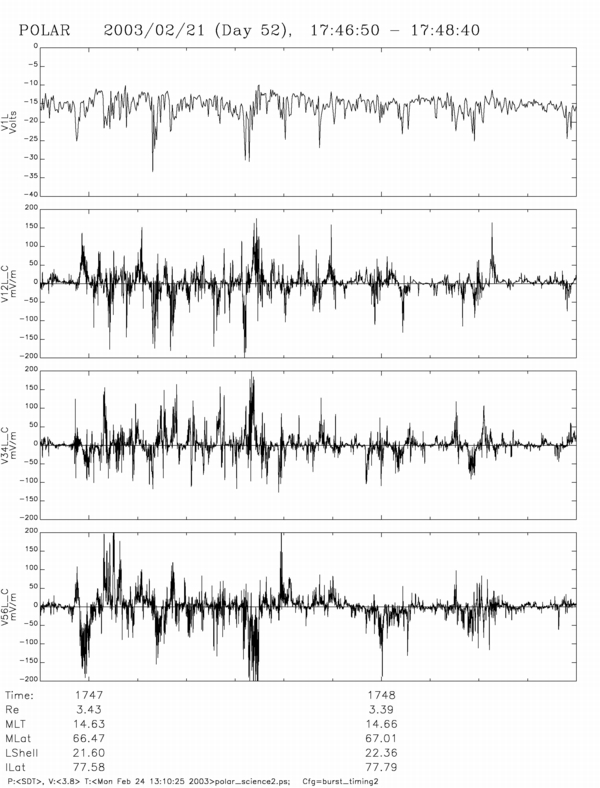
15 min: Chris Russell/Guan Le - Science Presentation from MFE
15 min: Science mode 2 Operations
- Results of 1-hour test: Steve Hearn on the FOT perspective, including LZ processing
- Results of 1-hour test: George Parks on the UVI perspective
- Results of 1-hour test: Bobby Candey on the PWG data processing perspective
- Results of 1-hour test: Everyone else regarding operations/ability to cope with NRT and LZ
- Plans for March 4-26 'test': Steve Hearn and Scott Boardsen
- Discussion of pros and cons regarding 20-day test
| click for larger size image | |
|---|---|
|
|
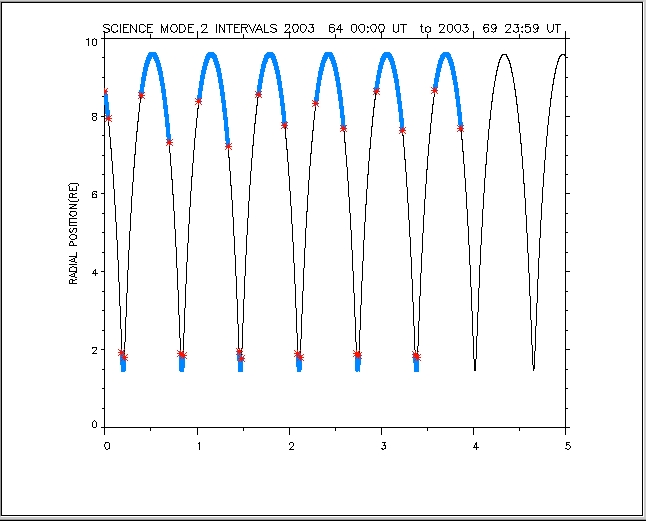
Following is a list of intervals Scott Boardsen proposes for science mode 2. They
are intervals in which sun avoidance or SEPS sun exposure avoidance is occurring, so the IMAGERS are not pointed at the Earth. These intervals
are indicated by blue in the attached plot, the x-axis
is the time in days from day 64 (March 3), 2003. The operations schedule
is also available.
| Proposed Science Mode 2 Intervals (pre-flip only) |
|---|
| 2003 64 00:00 UT 2003 64 01:02 UT 62.000000 min |
| 2003 64 05:19 UT 2003 64 06:04 UT 45.000000 min |
| 2003 64 11:17 UT 2003 64 20:04 UT 527.00000 min |
| 2003 64 23:39 UT 2003 65 00:25 UT 46.000000 min |
| 2003 65 05:22 UT 2003 65 14:29 UT 547.00000 min |
| 2003 65 17:57 UT 2003 65 18:42 UT 45.000000 min |
| 2003 65 23:58 UT 2003 66 08:13 UT 495.00000 min |
| 2003 66 12:18 UT 2003 66 13:02 UT 44.000000 min |
| 2003 66 17:55 UT 2003 67 02:38 UT 523.00000 min |
| 2003 67 06:37 UT 2003 67 07:23 UT 46.000000 min |
| 2003 67 12:45 UT 2003 67 21:00 UT 495.00000 min |
| 2003 68 00:57 UT 2003 68 01:40 UT 43.000000 min |
| 2003 68 07:06 UT 2003 68 15:16 UT 490.00000 min |
30 min: Senior Review FY03
Proposal development schedule:
For screen resolution version see: http://pwg.gsfc.nasa.gov/polar/SenRev2003/SenRev_v2.3screen.pdf
For print resolution version see: http://pwg.gsfc.nasa.gov/polar/SenRev2003/SenRev_v2.3_print.pdf
For mirocosoft word files of each section: http://pwg.gsfc.nasa.gov/polar/SenRev2003/word_files/
Current listing of objectives:
| 3.1 | Symmetry Violations: What are the fundamental magnetosphere-ionosphere coupling processes influenced and controlled by inter-hemispherical asymmetries? Is substorm onset behavior symmetric between northern and southern hemispheres? Are the effects of ionospheric conductivity local or global? |
| 3.2 | Descent to Solar Minimum: Inner Magnetosphere Particle Acceleration and Circulation Associated with High-Speed Solar Wind Streams. Why are recurrent highspeed solar wind streams more effective in producing intense radiation belts? How can we relate the efficiency of various radial transport and pitch angle scattering processes to solar wind input? What are the acceleration and transport mechanisms responsible for the sudden creation of new radiation belts? |
| 3.3 | Breaking the Resolution Barrier: Obtain new understanding of ion and electron diffusion regions, solitary wave structures, and the role of small scale field structures. Are solitary wave structures localized within the magnetopause layer? What terms in the generalized OhmÕs law are important in controlling reconnection and the physics of sharp boundaries? How does the Earth's bow shock and the steady or transient reconnection over the dayside portions of the magnetosphere mediate and filter the interplanetary input to the terrestrial system? |
| 3.4 | Quantitative Impact of the Ionosphere, exploiting Polar's new position in the SEC fleet: Quantify the variable electromagnetic linkage between the solar wind and the ionosphere along with its reactive energy and plasma storage that introduces new dynamics into the system. What are the temporal/spatial dynamics of the cusp in relation to the IMF and dynamic pressure? What is the role of terrestrial plasmas in the dynamics of the plasma sheet and plasma sheet boundary layer? How do thermal plasmas interact at the magnetopause boundary layer? Does UV insolation control Space Weather via auroral electrodynamics and load interactions? |
NEXT TELECON:
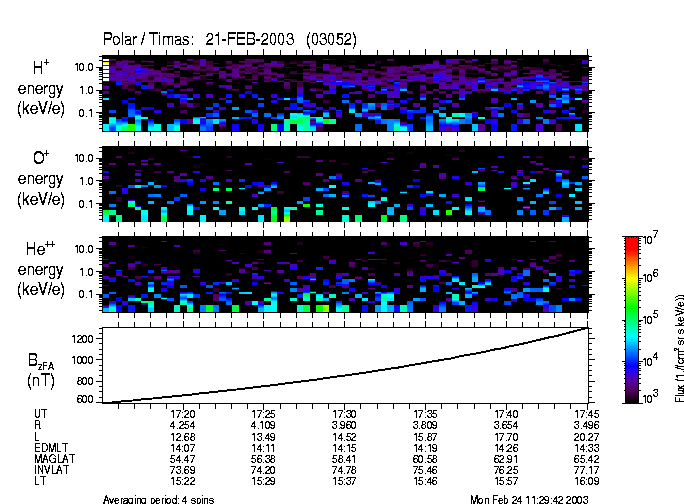
- March 21. TIMAS science!
- Another Senior Review telecon on March 7?
Send additions/corrections to barbara.l.giles@nasa.gov
Send corrections/additions to barbara.l.giles@nasa.gov